
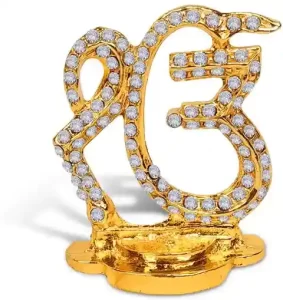
Ik Onkar
Ik Onkar is one of the most sacred and defining symbols of Sikhism. It appears at the very opening of the Guru Granth Sahib and expresses the essence of Sikh spiritual philosophy in its simplest form. For Sikhs around the world, Ik Onkar is the foundation of faith, identity, and understanding of the Divine.
Meaning of Ik Onkar –
The phrase Ik Onkar is composed of two words:
- Ik – meaning One
- Onkar – meaning Creator, the Divine who brings everything into existence
Together, Ik Onkar means –
There is One Universal, Eternal, Formless God.
This simple yet profound statement affirms that God is one, without form, beyond birth and death, and present in every particle of creation. Everything originates from this One Supreme Power, and everything eventually merges back into it.
Spiritual Significance –
Ik Onkar is not only a symbol; it is a philosophy that defines the Sikh worldview:
1. Oneness of God
- Sikhism rejects the idea of multiple gods or divine incarnations.
- Ik Onkar clearly states that all existence comes from one source.
2. Oneness of Humanity
- If God is one and present in all beings, then all humans are equal.
- This belief inspires Sikhs to reject discrimination based on caste, gender, race, or religion.
3. Unity of Creation
- Ik Onkar teaches that everything in the universe is interconnected.
- Nothing is separate from the Divine presence.
4. Continuous Divine Presence
- The Creator does not separate from creation.
- The Divine energy flows through all life.
Philosophical Depth –
Ik Onkar is also connected to the larger concept of Mool Mantar, the opening verse of the Guru Granth Sahib, which describes the qualities of God—Timeless, Fearless, Compassionate, and Self-Existent.
Ik Onkar serves as the gateway to this divine understanding. It invites every seeker to begin the spiritual journey with the realization of the One Truth.
Symbolic Representation –
Visually, Ik Onkar is written in the Gurmukhi script. The design itself holds meaning:
- The numeral “1” shows the singularity and unity of the Divine.
- “Onkar” symbolizes the creative power that sustains the universe.
This symbol is widely found in Sikh homes, gurdwaras, scriptures, artworks, jewelry, and decorative pieces. It stands as a constant reminder of the presence of God in every moment.
Role in a Sikh’s Life –
Ik Onkar guides Sikhs in:
1. Daily Prayer
Sikhs remember God through Naam Simran (meditation), beginning with the understanding that the same Divine Light lives within all.
2. Moral Living
The message of Ik Onkar inspires compassion, truthfulness, honesty, humility, and love for all.
3. Community Service
Seva (selfless service) is rooted in the belief that serving others is equal to serving God.
4. Equality and Justice
Since the One Creator resides in every individual, Sikhs stand firmly against oppression, inequality, and injustice.

Khanda
The Khanda is one of the most iconic and powerful symbols of Sikhism. Recognized instantly by Sikhs around the world, it represents the core principles of Sikh faith—spiritual wisdom, justice, courage, and the unity of God. More than just an emblem, the Khanda is a visual expression of Sikh identity and the teachings of the Gurus.
What Is the Khanda?
The Khanda is a composite symbol made up of four distinct elements, each holding deep meaning. Together, these elements present the Sikh vision of a balanced and righteous life.
The emblem consists of:
- A central double-edged sword (Khanda)
- A circular Chakkar (disc)
- Two single-edged kirpans (swords) on the sides
Each part has a unique significance, but together they create a powerful spiritual and moral message.
Elements of the Khanda and Their Meanings –
1. The Double-Edged Sword (Khanda) – Center
This sword gives the symbol its name. It is placed vertically at the center.
- Represents divine knowledge
- Symbolizes the ability to cut through illusion, ignorance, and falsehood
- Reflects truth, purity, and the sharpness of spiritual wisdom
The double edge shows that truth applies equally to the physical and spiritual worlds.
2. The Chakkar – Circle Around the Sword
The Chakkar is a circular disc with no beginning or end.
- Symbolizes eternity, infinity, and the timeless nature of God
- Represents unity and the interconnectedness of all creation
- Reflects the Sikh belief in equality and the absence of discrimination
Its shape conveys that the Divine is eternal, formless, and without limits.
3. The Two Kirpans – Miri and Piri
Flanking the Chakkar on both sides are two curved swords (Kirpans).
These represent the Sikh doctrine of:
- Miri – Temporal authority (justice, courage, responsibility in worldly affairs)
- Piri – Spiritual authority (faith, devotion, and divine guidance)
Together, the two kirpans symbolize a balanced life—one that harmonizes spiritual growth with ethical leadership and social responsibility.
Philosophy Behind the Khanda –
The Khanda embodies the Sikh ideal of the saint-soldier (Sant-Sipahi):
a person who meditates on God yet stands firmly for justice and truth.
It teaches that:
- Spirituality must not ignore worldly responsibilities
- Justice must be rooted in compassion and divine understanding
- Strength should be used to protect, not to oppress
- A Sikh must live with courage but also humility
The Khanda is a reminder to uphold righteousness even in the face of adversity.
Historical and Cultural Importance –
The symbol evolved during the era of Guru Hargobind Sahib Ji, who introduced the principles of Miri and Piri, and later became a central emblem of the Khalsa during Guru Gobind Singh Ji’s time.
Today, the Khanda:
- Appears on Nishan Sahib, the Sikh flag
- Adorns gurdwaras, scriptures, ceremonial items, and Sikh art
- Is worn on turbans, clothing, and jewelry as a sign of faith
- Represents unity, dignity, and the Sikh commitment to justice
Spiritual and Practical Lesson of the Khanda –
The Khanda encourages Sikhs to:
- Seek truth and wisdom
- Live with fearlessness and integrity
- Fight injustice wherever it appears
- Stay spiritually grounded while engaging in real-world responsibilities
- Maintain balance between devotion and action
It captures the heart of Sikh philosophy—a life of courage, fairness, and devotion to the Creator.
Nishan Sahib
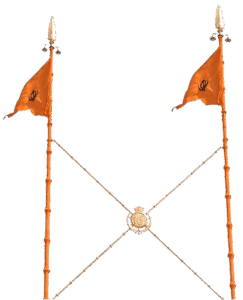
The Nishan Sahib is the sacred Sikh flag that stands proudly outside every Gurdwara around the world. More than a religious symbol, it represents the spirit, identity, and sovereignty of the Sikh community. The Nishan Sahib is a universal sign that proclaims:
This is the house of God, open to all, without discrimination.
What Is the Nishan Sahib?
The Nishan Sahib is a tall flagpole covered with cloth, usually saffron or deep blue, topped with a Khanda symbol. The triangular or rectangular flag that flies at its peak carries immense spiritual and historical importance for Sikhs.
It is not simply a flag—it is a living symbol of the Sikh faith, the Khalsa spirit, and the eternal presence of the Guru.
Symbolism of the Nishan Sahib –
1. Color of the Flag
The flag is traditionally saffron (Kesri), though sometimes Navy Blue is also used.
- Saffron (Kesri): Represents sacrifice, courage, purity, and spiritual devotion.
- Blue: Represents bravery, warrior spirit, and the Khalsa order.
These colors highlight the Sikh values of fearlessness, service, and dedication to God.
2. The Khanda Emblem
The center of the flag carries the Khanda, the iconic Sikh symbol.
It represents:
- Divine wisdom
- The eternal nature of God
- Balance between spiritual responsibility (Piri) and worldly responsibility (Miri)
The presence of the Khanda reinforces the message of truth, justice, and righteousness.
3. The Flagpole (Nishan Sahib Pole)
The tall flagpole is usually wrapped in cloth, both for respect and protection.
Its height symbolizes:
- The lofty principles of Sikhism
- The visibility of the Guru’s house for anyone seeking help
- The standing presence of the Khalsa in the world
Many Gurdwaras use steel or iron poles, signifying strength and resilience.
Historical Significance –
The origins of the Nishan Sahib date back to the time of the Sixth Guru, Guru Hargobind Sahib Ji, who introduced the concept of Miri and Piri (temporal and spiritual authority). The flag embodied the spirit of independence, courage, and divine mission.
Later, during the formation of the Khalsa by Guru Gobind Singh Ji in 1699, the Nishan Sahib became even more prominent as a symbol of the collective identity of the Sikhs.
Throughout Sikh history, the Nishan Sahib has:
- Led Sikh armies into battle
- Marked gatherings of the Khalsa
- Identified Sikh camps, langars, and relief sites
- Represented protection and sanctuary for all
It has stood as a symbol of hope even in the most difficult times.
Where You See the Nishan Sahib Today –
1. Outside Every Gurdwara
The Nishan Sahib is always placed at the entrance, often visible from afare.
It invites people from all walks of life into:
- Prayer
- Service (Seva)
- Community meals (Langar)
- Peace and sanctuary
2. During Processions and Nagar Kirtan
Special flags resembling the Nishan Sahib are carried at the front of Sikh processions, representing the Guru’s presence.
3. Used in Relief and Humanitarian Work
During natural disasters or humanitarian crises, Sikh organizations place the Nishan Sahib to mark relief centers. It assures people of food, safety, and help, regardless of religion or background.
Spiritual Meaning of the Nishan Sahib –
The Nishan Sahib reminds Sikhs of:
- Hukam (Divine Will)
- Seva (selfless service)
- Sarbat da Bhala (well-being of all)
- Upholding truth, justice, and equality
- Living with courage and compassion
It stands as an eternal symbol of faith, freedom, and selfless service.
Raising and Honoring the Nishan Sahib –
Every year, Gurdwaras perform a special ceremony called “Nishan Sahib Seva”, where:
- The cloth covering the flagpole is removed
- The pole is washed with milk and water
- A fresh cloth is wrapped around it
- The flag is renewed
This is an act of devotion and respect, symbolizing purity and the constant renewal of the Sikh spirit.
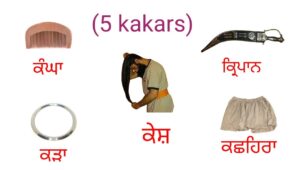
The Five K’s (Panj Kakkaar)
The Five K’s, known as Panj Kakkaar, are the five sacred articles of faith that all initiated Sikhs (Khalsa) are required to wear at all times. Introduced by Guru Gobind Singh Ji in 1699 during the creation of the Khalsa, these symbols represent a Sikh’s commitment to discipline, identity, spirituality, and the path of righteousness.
Each of the Five K’s begins with the letter ‘K’ in Punjabi, and together they form a visible expression of Sikh values and a reminder of the responsibilities of the Khalsa.
1. Kesh (ਕੇਸ਼) – Uncut Hair :
Meaning & Significance
Kesh refers to keeping hair in its natural, unaltered state—uncut, untrimmed, and respected as a divine gift from God. Sikhs maintain long hair as a symbol of spirituality, acceptance of natural form, and submission to God’s will.
Symbolism
- Represents living in harmony with nature
- Signifies spiritual strength and maturity
- Reminds Sikhs to remain connected to their roots
- Symbolizes respect for the body, which is considered sacred
Kesh is usually covered with a Dastar (turban) to protect and honor it.
2. Kara (ਕੜਾ) – Iron Bracelet :
Meaning & Significance
The Kara is a circular iron or steel bracelet worn on the wrist. Its round shape has no beginning and no end, symbolizing the eternal nature of God.
Symbolism
- A reminder to perform righteous deeds
- Represents the bond between the Sikh and the Guru
- Acts as a protective symbol against negativity
- Encourages discipline and moral action
The Kara also reflects humility—simple in design, yet spiritually powerful.
3. Kanga (ਕੰਗਾ) – Wooden Comb :
Meaning & Significance
The Kanga is a small wooden comb used to keep the hair clean and tidy. It is usually kept inside the turban.
Symbolism
- Represents cleanliness, discipline, and order
- Encourages a balance between spiritual and physical hygiene
- Reminds Sikhs to maintain an organized and thoughtful life
The Kanga teaches that inner purity must be reflected in outer cleanliness.
4. Kachera (ਕਛਹਰਾ) – Cotton Undergarment :
Meaning & Significance
The Kachera is a pair of special cotton undergarments designed for comfort, mobility, and modesty.
Symbolism
- Represents self-control and moral discipline
- Encourages modest behavior and respectful conduct
- Symbolizes readiness and alertness—ideal for warriors
- Reflects purity of actions and thoughts
It was originally designed to give Sikh warriors freedom of movement while also promoting modesty.
5. Kirpan (ਕਿਰਪਾਨ) – Ceremonial Sword :
Meaning & Significance
The Kirpan is a small ceremonial sword representing the duty to protect truth, justice, and the weak. It is not a weapon of aggression, but a symbol of responsibility and righteousness.
Symbolism
- Represents courage and the duty to stand against oppression
- Symbolizes the fight against injustice, tyranny, and evil
- Encourages compassion and protection of the vulnerable
- Reminds Sikhs of their martial heritage and spiritual courage
The word Kirpan comes from:
- Kirpa – grace, compassion
- Aan – honor, dignity
Together, they signify a sword of mercy and honor.
Purpose of the Five K’s –
The Panj Kakkaar serve as:
- Daily reminders of a Sikh’s values
- Symbols of unity, worn by Sikhs around the world
- Tools to maintain discipline and spiritual focus
- Signs of commitment to the Khalsa lifestyle
- Visible identity markers of courage, virtue, and devotion
They are not merely objects—they are a way of life.