
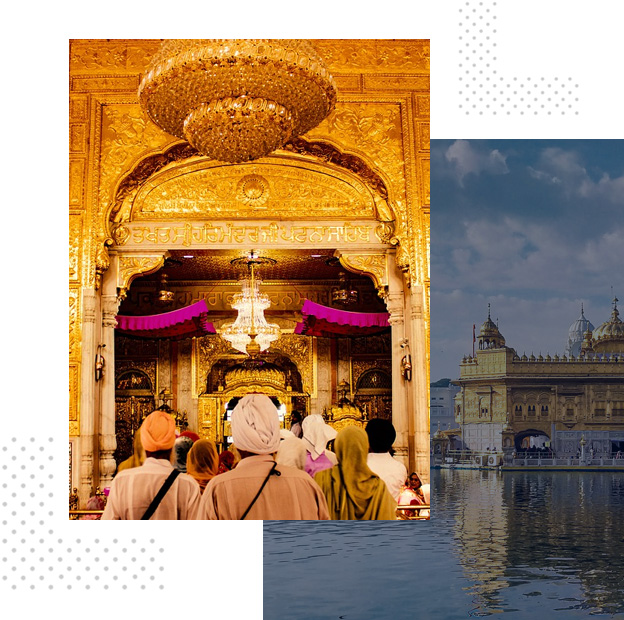
Introduction to Sikhism
Sikhism is an Indian, monotheistic, ethnic religion and philosophy that originated in the Punjab region of the Indian subcontinent around the end of the 15th century CE. It is one of the most recently founded major religions and is followed by 25–30 million adherents, known as Sikhs.
Sikhism developed from the spiritual teachings of Guru Nanak ji (1469–1539), the faith’s first guru, and the nine Sikh gurus who succeeded him. The tenth guru, Guru Gobind Singh (1666–1708), named the Guru Granth Sahib, which is the central religious scripture in Sikhism, as his successor. This brought the line of human gurus to a close. Sikhs regard the Guru Granth Sahib as the 11th and eternally living guru.
The core beliefs and practices of Sikhism, articulated in the Guru Granth Sahib and other Sikh scriptures, include faith and meditation in the name of the one creator (Ik Onkar), the divine unity and equality of all humankind, engaging in selfless service to others (seva), striving for justice for the benefit and prosperity of all (sarbat da bhala), and honest conduct and livelihood.
Following this standard, Sikhism rejects claims that any particular religious tradition has a monopoly on absolute truth. As a consequence, Sikhs do not actively proselytise, although voluntary converts are generally accepted. Sikhism emphasises meditation and remembrance as a means to feel God’s presence (simran), which can be expressed musically through kirtan or internally through naam japna (lit. ’meditation on God’s name’). Baptised Sikhs are obliged to wear the five Ks, which are five articles of faith which physically distinguish Sikhs from non-Sikhs. Among these include the kesh (uncut hair). Most religious Sikh men thus do not cut their hair but rather wear a turban.
The religion developed and evolved in times of religious persecution, gaining converts from both Hinduism and Islam. The Mughal emperors of India tortured and executed two of the Sikh gurus—Guru Arjan (1563–1605) and Guru Tegh Bahadur (1621–1675)—after they refused to convert to Islam. The persecution of the Sikhs triggered the founding of the Khalsa by Guru Gobind Singh in 1699 as an order to protect the freedom of conscience and religion, with members expressing the qualities of a sant-sipahi(“saint-soldier”).
History of Sikhism
Sikhism began in 1469 with the birth of Guru Nanak Dev Ji in the village of Talwandi (now Nankana Sahib, Pakistan). From a young age, Guru Nanak questioned social divisions, rituals, caste barriers, and injustices that were common in society.
After receiving a divine revelation at the age of 30, Guru Nanak declared:
There is no Hindu, there is no Muslim all are children of One God.
He traveled across India, the Middle East, Tibet, and South Asia to spread the message of:
- Oneness of God
- Unity of humanity
- Equality and justice
- Honest living
- Remembering God through Naam
- Rejecting rituals, caste, and discrimination
These teachings laid the foundation for a new spiritual and social movement — Sikhism.
Era of the Ten Gurus (1469 – 1708)
The era of the Ten Sikh Gurus marks the foundation and evolution of Sikhism over nearly two and a half centuries. Beginning with the birth of Guru Nanak in 1469, this period witnessed a powerful blend of spiritual wisdom, social reform, and the gradual transformation of the Sikh community into a united and disciplined society.
Guru Nanak Dev Ji laid the core principles—belief in one universal God, equality of all people, rejection of superstition, caste, and ritual practices. His message of Naam Japna, Kirat Karni, and Vand Chakna created a new path of honest living and shared humanity.
Each succeeding Guru strengthened and expanded this mission:
- Guru Angad Dev Ji standardized the Gurmukhi script.
- Guru Amar Das Ji promoted social equality and established the langar system firmly.
- Guru Ram Das Ji laid the foundation of Amritsar.
- Guru Arjan Dev Ji compiled the Adi Granth and built the Harmandir Sahib.
- Guru Hargobind Sahib Ji introduced the concept of Miri-Piri, combining spiritual and temporal responsibility.
- Guru Har Rai Ji, Guru Har Krishan Ji, and Guru Tegh Bahadur Ji nurtured compassion, sacrifice, and protection of religious freedom.
- Guru Gobind Singh Ji, the tenth Guru, created the Khalsa in 1699, giving Sikhs a distinct identity and transforming them into a community of saint-soldiers.
Together, the Ten Gurus shaped a progressive, egalitarian, and resilient faith. Their combined teachings built the spiritual foundation and social structure of Sikhism, leading up to the moment when Guru Gobind Singh Ji ordained the Guru Granth Sahib as the eternal Guru in 1708.
Compilation of Guru Granth Sahib
The creation of the Guru Granth Sahib stands as one of the most significant achievements in Sikh history. It represents the preservation of divine wisdom, spiritual harmony, and the universal message taught by the Sikh Gurus. The compilation process began under Guru Arjan Dev Ji, the fifth Sikh Guru, who envisioned a scripture that would protect Sikh teachings from distortion and unite the community around authentic spiritual guidance.
Guru Arjan Dev Ji personally collected the hymns of the earlier Gurus, including the sacred verses of Guru Nanak, Guru Angad, Guru Amar Das, and Guru Ram Das. Along with these teachings, he also included the writings of enlightened saints and mystics from diverse backgrounds—Hindu, Muslim, and others—who shared the message of devotion, equality, and oneness of the Divine. This inclusive approach made the scripture a universal treasure, transcending caste, religion, and social boundaries.
In 1604, the first version, known as the Adi Granth, was completed and respectfully installed inside the Harmandir Sahib (Golden Temple). Baba Buddha Ji served as the first granthi (scripture caretaker).
Later, in 1708, Guru Gobind Singh Ji bestowed the eternal Guruship upon this sacred scripture, expanding it by adding the hymns of Guru Tegh Bahadur Ji. From that moment onward, the Guru Granth Sahib became the final, living, and eternal Guru of the Sikh community.
Today, the Guru Granth Sahib continues to guide millions with its universal message of love, humility, righteous living, and devotion to the One Creator.
Sikh Resistance and Martyrdom
During the 17th and early 18th centuries, Sikhism faced severe persecution by Mughal rulers. Sikhs refused forced conversions and resisted injustice, leading to a period of intense struggle.
Key martyrs and events:
- Guru Arjan Dev Ji: First Sikh martyr executed for refusing to alter Sikh scripture.
- Guru Tegh Bahadur Ji: Gave his life defending the religious rights of Kashmiri Hindus.
- Sahibzade (sons of Guru Gobind Singh Ji):
- Ajit Singh & Jujhar Singh: Martyred in battle at Chamkaur.
- Zorawar Singh & Fateh Singh: Bricked alive for refusing to convert.
- Banda Singh Bahadur: Fought to free the oppressed peasants; executed in 1716.
Despite these atrocities, the Sikh spirit grew stronger. This era transformed Sikhs into saint-soldiers, committed to both spirituality and justice.
Rise of the Sikh Empire (1799–1849)
The rise of the Sikh Empire marks one of the most remarkable chapters in Indian history. Emerging from a period of political chaos, invasions, and fractured regional control, the Sikhs transformed themselves into a powerful and unified force under visionary leadership. This era reflects a blend of military strength, administrative innovation, and a deep commitment to justice and pluralism.
After decades of resistance against Mughal and Afghan oppression, the Sikh community had organized itself into various autonomous groups known as misls. While these misls were strong and fiercely independent, they lacked a central authority. This structure changed with the emergence of Maharaja Ranjit Singh, a charismatic and strategic leader who unified the misls and laid the foundation of a stable and prosperous Sikh state.
In 1799, Ranjit Singh took control of Lahore, which soon became the capital of the Sikh Empire. Under his rule, the empire grew into one of the most powerful and respected kingdoms in Asia. His governance was marked not only by military brilliance but by a spirit of secularism and inclusion. People of all faiths—Hindus, Muslims, and Christians—held key positions in the administration and army, reflecting the Sikh belief in equality and justice.
The empire expanded significantly, stretching from the Sutlej River in the east to the Khyber Pass in the west. Commanders like Hari Singh Nalwa played a crucial role in defending and extending the frontiers, particularly in the northwest, where they prevented Afghan invasions and secured the region.
Beyond military accomplishments, the Sikh Empire became known for its reforms. Ranjit Singh modernized the army with European training and technology, improved trade, restructured revenue systems, and supported art, architecture, and culture. His reign brought stability to Punjab after centuries of conflict.
The empire continued to flourish even after his passing, though internal struggles and increasing British interference gradually weakened its structure. By 1849, after two Anglo-Sikh wars, the British East India Company annexed Punjab, marking the end of the Sikh Empire.
Even though the political power ended, the legacy of the Sikh Empire remains alive—symbolizing courage, unity, administration based on fairness, and a golden period of Sikh sovereignty that still inspires pride across the world.
Sikh Community in Modern India and the World
The Sikh community today stands as a vibrant global society, rooted in strong spiritual values while actively contributing to modern life. From India to every major continent, Sikhs have built a reputation for resilience, service, and leadership.
In modern India, Sikhs play an influential role across various sectors. Punjab remains the cultural and spiritual heartland of Sikhism, home to the Golden Temple and the world’s largest Sikh population. Sikhs are recognized nationally for their contributions to agriculture, defense, entrepreneurship, sports, and public service. The principles of hard work, equality, and community service continue to shape their identity in India’s social and economic landscape.
Beyond India, the Sikh diaspora has flourished across countries like Canada, the United Kingdom, the United States, Australia, Malaysia, and East Africa. Migration that began during the colonial period has now grown into well-established communities that actively contribute to their adopted nations. Sikhs today serve as lawmakers, judges, soldiers, educators, scientists, business leaders, and philanthropists in many parts of the world.
A defining hallmark of the Sikh community is seva (selfless service). This tradition has earned global admiration, especially visible through massive humanitarian efforts. Sikh organizations regularly provide free meals, disaster relief, and community support without discrimination. The practice of langar, the free community kitchen, continues worldwide as a symbol of equality and compassion.
Culturally, Sikhs have embraced their heritage while staying connected to global progress. Gurdwaras around the world serve not only as places of worship but also as hubs of social unity, cultural education, and charity.
Today, the Sikh community stands at the intersection of tradition and modernity—deeply connected to its historical roots while actively participating in shaping the world’s future. With strong values of courage, service, and universal brotherhood, Sikhs continue to inspire and uplift societies across the globe.
Sikhism Today:
- Punjab in India remains the heartland of Sikh culture and spirituality.
- Sikhs form a global community across:
- Canada
- United Kingdom
- United States
- Australia
- Europe
- New Zealand
- Southeast Asia
- Known for contributions in farming, military, entrepreneurship, technology, sports, philanthropy, and community service.
- Sikh organizations run thousands of humanitarian initiatives including free kitchens, disaster relief, refugee support, and medical camps worldwide.